
17 August 2026
Objection Handling Fact Sheet
Written By:
Tiller Team

OBJECTION FACT SHEET
Objection Handling: Right in Theory, Costing You Deals in Practice
What the data shows about where the standard playbook holds, and where it doesn't
Sales training runs on theory, because theory scales. A shared framework beats no framework at all, and for years that trade-off was worth making. But it predates the ability to measure what actually happens call by call, or to support a rep live, mid-conversation. Neither limit exists now. The data shows exactly where the old framework is still costing you deals it should win.
The traditional playbook tells reps to do the following when a deal stalls:
Price objections: reps are taught to negotiate. Leading with price alone resolves 52% of objections. Quantifying the cost of the problem first, then bridging to value, lifts that to 71%.
Timing objections: reps are taught to push urgency. The data says otherwise. One question, asking when the prospect actually needs this live, resolves 82% of timing objections, because it separates a real deadline from a stalling tactic.
The Big Picture
From our data the objections fall into eight categories. “Resolved” means the deal kept moving after the objection came up.
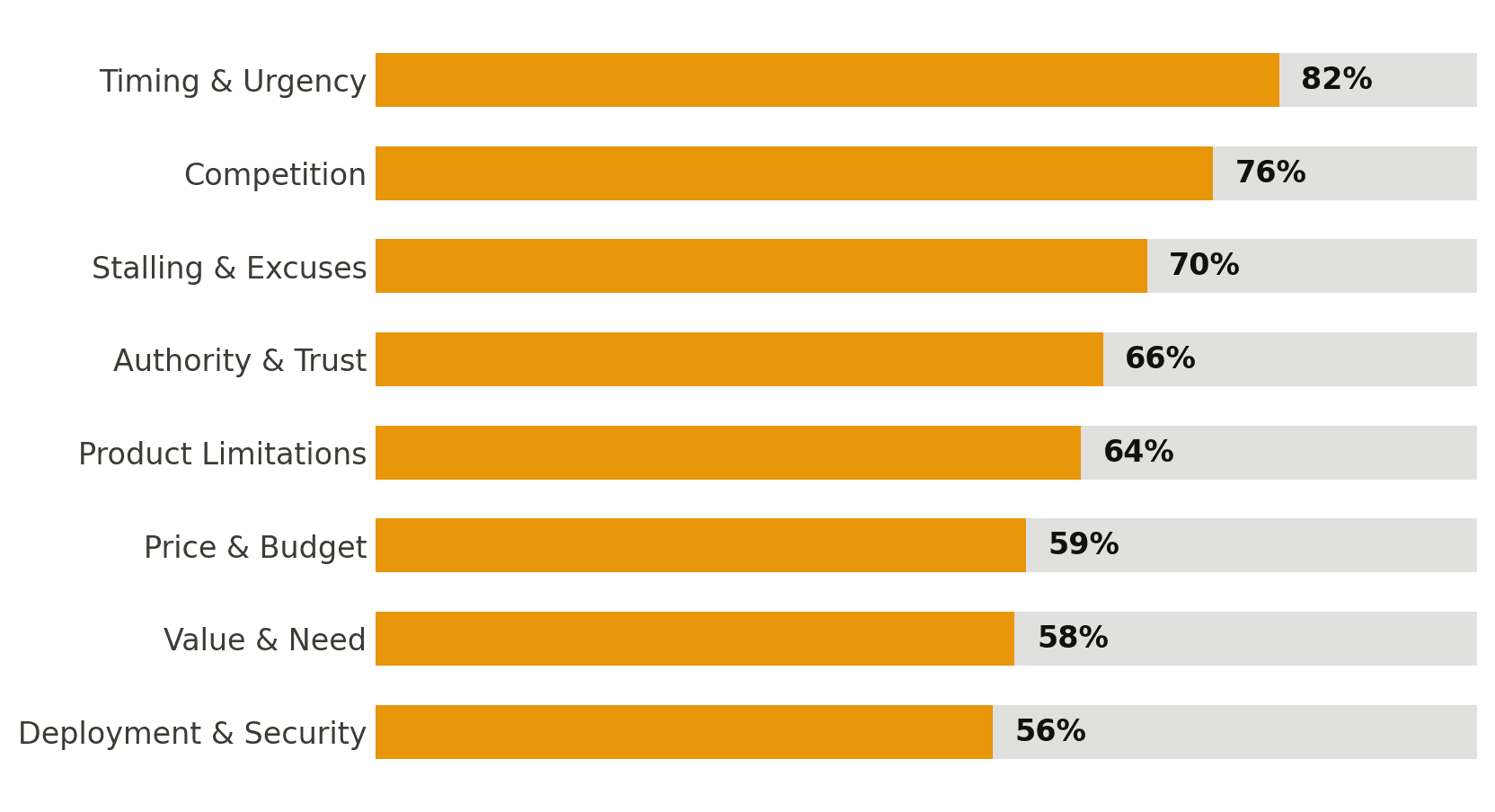
Three approaches recur across the data. Each solves a different problem. Using the wrong one caps the result before the conversation starts.
1. Listen, acknowledge, question
The default. Works widely. Has a ceiling.
Most reps reach for this first, and it holds up in most categories. Three steps: listen before responding, acknowledge without agreeing, then ask a question that hands the conversation back to the prospect.
A prospect needs to loop in another decision-maker. Instead of arguing against it, the rep acknowledges it, then asks what timeline to expect once that person is involved. The question does most of the work.
Skip the acknowledgement and argue straight past the objection, and the deal is lost 41% more often.
It performs best on timing (82%), stalling (70%), and authority (66%): a good question separates a real blocker from a delay tactic. It performs worse on price (59%) and deployment and security (56%). Questions alone don't close a value gap or a technical one.
Takeaway: this approach buys time to diagnose the real objection. Alone, it won't resolve price or technical objections. Those need something layered on top. |
2. Reframe to value
The price specialist. Lifts resolution from 52% to 71%.
Never used alone. Always layered on the default approach, and built specifically for price and value objections. Three steps.
Ask what the problem already costs the prospect, in time or money, before mentioning your price. Reps who do this resolve 71% of price objections. Reps who lead with price resolve 52%, a 19 point gap.
Bridge cost to value: shift from “what does this cost” to “what is it costing you not to have this.”
If the number still won't move, offer flexibility on timing, such as shifting the first invoice date, instead of a discount. It solves the objection without giving up margin.
Takeaway: a price objection is rarely about the number. It's about whether the prospect has quantified the cost of the problem. Do that first, and the price conversation gets easier. |
3. Qualify or disqualify
The blocker separator. Lifts product objection resolution from 64% to 78%.
This is where the most time gets wasted. Product limitation objections are a highly raised category, so this approach has the biggest impact at scale.
Ask directly whether a missing capability is a dealbreaker, or something workable. One question separates three situations: a real gap worth fixing, a workaround, and a genuine dealbreaker.
If it's a genuine dealbreaker, say so and move on. Reps who do this preserve credibility, and save hours on deals that were never winnable.
If it's workable, reposition directly: name how much of the requirement is already covered, and what it takes to close the rest.
Resolved this way, product objections hit 78%, against 64% for the default approach alone, a 14 point lift. The same logic lifts competition objections from 68% to 76%: asking whether a competitor's extra feature would actually get used surfaces whether it's a real reason to walk, or just a nice-to-have.
Takeaway: not every objection is winnable. Trying to win them all wastes time. Work out early whether it's a real gap, a workaround, or a dead end, and respond accordingly. |
How to coach this?
In practice:
Match the approach to the objection. The default works everywhere as a starting point, but price and product objections need an extra layer.
For price objections, always quantify what the problem is costing the prospect before quoting your own price. That one habit is worth a 19 point swing in resolution.
For product and feature objections, work out early whether it's a dealbreaker or workable. Don't sell past a wall that isn't moving.
One last thought: How do you get the team to actually execute this live, in the meeting, when it counts. That challenge is familiar to every sales leader, because it's not a knowledge problem, it's an execution one. If it sounds familiar, it's worth learning more about how Tiller helps close that gap. |
From the Tiller Blog:
User Roles
Tiller's New Role-Based Privacy Controls Explained
1 Oct 26

Tiller desktop app isn't recording on macOS
Tiller not recording meetings on your Mac? It's usually a missing macOS permission. Here's how to turn on Accessibility, Screen & System Audio Recording and Microphone access so you're recording again in a couple of minutes.
23 September 2026

Ask Ari Actions: Get the Right Answer, Live, On Every Call
Stop losing deals to a question you couldn't answer. Watch how Ask Ari Actions gives your whole team the right answer, live, on every call.
21 September 2026